



Image
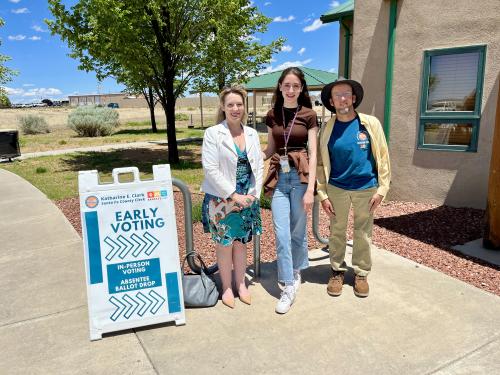
As part of the 10th anniversary of the Clearinghouse Awards, the U.S. Election Assistance Commission (EAC) is spotlighting previous Clearie winners, including the Santa Fe County Clerk’s Office in New Mexico.
The EAC interviewed Santa Fe County Clerk Katharine Clark on the office’s 2025 Clearie award-winning program, Voting Without Barriers: Santa Fe County. It was recognized in the “Best Practices for Improving Accessibility for Voters with Disabilities” category.
EAC Q&A: KATHARINE CLARK, SANTA FE COUNTY CLERK
1. How did you learn about the EAC Clearie program, and what motivated you to author your jurisdiction’s Clearie entry?
Our office has been engaged with the Clearie program for several years. It’s well known among election administrators, and we’ve been fortunate to submit entries and receive recognition across multiple categories going back to 2021. What motivates us to keep participating is the spirit of the program itself. The Clearies are about sharing innovation and best practices so that other jurisdictions can build on it. That mission aligns with how we try to operate. When we develop something that genuinely improves the voter experience, we want to put it out there in the hopes of inspiring other election offices.
2. What was the motivation behind developing your program’s three-part accessibility initiative?
Our office has been working on disability issues since I was first elected County Clerk and took office in 2021. We had the idea of creating an accessibility guide for each of the polling sites. We survey all our polling sites to ensure ADA compliance, but compliance doesn't mean every site is equally convenient. Some locations have more accessible parking, shorter distances from the car to the door, or other features that make a meaningful difference for voters with mobility needs. Election Administrative Specialist Gary Reid developed the site guides, documenting accessibility features at each voting location to help voters better plan their visit.
Another idea we had was the Disability Access Advisory Board, which was started alongside a series of boards representing various stakeholder groups. Gary Reid serves as Chair of the Disability Access Advisory Board, and under his leadership, the board’s input helped shape and expand our approach to accessibility across the office.
Once we had the guides, we wanted a central place for them to live and that became the Accessible Voting web page. Voter Outreach Coordinator Margaret Gouws developed the web page and built it out to include more than just the guides: information about accommodations available on our tabulators, voters’ rights when they need assistance marking a ballot, and options for voters who prefer to vote from home, like absentee voting and our Permanent Absentee List.
The ASL video component was an idea by our Deputy Clerk, Rosangela Ortiz, who had seen ASL voting education videos produced for the Secretary of State's website — but they were made in 2020 and had become a bit outdated. We wanted to create fresh, reusable content, and Voter Outreach Coordinator Margaret Gillett coordinated a partnership with the New Mexico Commission for Deaf and Hard of Hearing to produce them. Their expertise ensured the videos were accurate and accessible in a way that a written summary simply can’t replicate for voters who are deaf and hard of hearing.
Image
3. Tell us more about how your “three-part accessibility Initiative” has improved accessibility for voters with disabilities in Santa Fe County?
Each component addresses a different barrier. The ASL videos, developed in partnership with the New Mexico Commission for Deaf and Hard of Hearing, ensure that voters who are deaf and hard of hearing receive voting information directly in their primary language, not just a written summary. The Voting Site Guides give voters with mobility concerns the ability to plan their visit in advance: They can see exactly where to park, what the path to entry looks like, and what accommodations are available at their specific location. And the Disability Access Advisory Board has been transformative in terms of how we identify gaps, because the people with lived experience often see things we miss. Together, these tools shift our approach from reactive to proactive, and that makes a real difference for voters.
4. Your office was also recognized for honorable mention in 2022 in this same Clearie category. Speak to how Santa Fe County keeps a consistent focus on improving accessibility for voters with disabilities.
Accessibility has been a long-standing priority for this office. Our 2022 honorable mention recognized work that went above and beyond ADA requirements — things like drive-up absentee ballot drop boxes, expanded ADA parking, and poll worker training developed in partnership with Disability Rights New Mexico. That work laid a foundation, and the 2025 initiative built on it by adding new tools, new partnerships, and a more structured feedback mechanism through the advisory board. What keeps us consistent is the belief that accessibility isn't a box to check, it’s an ongoing commitment. Every election cycle is an opportunity to do better than the last.
Image
5. What does recognition by the EAC’s Clearie program mean to your office?
The EAC’s criteria specifically recognizes work that is innovative and replicable. Our initiative, being recognized with a Clearie means that other jurisdictions can actually adopt and adapt it for their own communities. Election offices across the country are constantly testing new approaches, and when something works, sharing it broadly is how the whole field moves forward. We all have the same goal: improving access, security, and public trust in elections. Being recognized with a Clearie means a lot to us because it signifies that the work we’ve done not only benefits our voters in Santa Fe County but can be replicated by election administrators across the nation to improve access for their own voters.
6. Would you recommend other jurisdictions submit a Clearie entry?
Absolutely, without hesitation. The process of putting together a Clearie entry is valuable in itself because it pushes you to articulate what you’ve done, why it worked, and how others could replicate it. That kind of reflection makes your programs stronger. And the exposure your work gets through the EAC network is genuinely useful. We've seen other counties in New Mexico emulate some of our programs, and we’ve learned from theirs. The election administration community is better when we share openly, and the Clearie program is one of the best vehicles we have for doing that.
7. Anything else you would like to add?
Santa Fe County has been proud to submit entries across multiple Clearie categories over the years. We believe strongly in both sharing our own best practices and learning from the innovative work happening in jurisdictions across the country. Programs like the Clearies make that exchange possible, and we're grateful to the EAC for continuing to celebrate and elevate the work of local election administrators nationwide.