



Image
2024 Clearie Award Winner
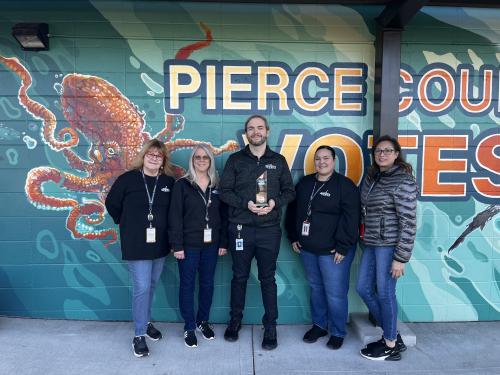
As part of the 10th anniversary of the Clearinghouse Awards, the U.S. Election Assistance Commission (EAC) is spotlighting previous Clearie winners, including Pierce County Elections in Washington.
The EAC interviewed Elections Manager Kyle Haugh on the office’s 2024 Clearie award-winning program for Innovation and New Tools in Election Security and Technology, “Securing Democracy's Inbox: An Air-Gapped Protocol for Processing Voter Email Attachments.”
In addition to this award, Pierce County Elections received a 2023 Clearie Award for “Creative and Original ‘I Voted’ Stickers,” and was honored with awards in 2017, 2021, and 2023, in the “Innovations or New Practices in Election Administration” category.
EAC Q&A: ELECTIONS MANAGER KYLE HAUGH, PIERCE COUNTY ELECTIONS
1. How did you learn about the EAC’s Clearinghouse Awards, and what motivated you to author your jurisdiction’s Clearie entry?
We first learned about the EAC Clearie Awards in 2017 at our state elections conference. Since then, we have been honored by the EAC several times, including for our ballot drop box program in 2021 and 2023, as well as our “I Voted” sticker and envelope design in 2023. The Clearie program is something we genuinely enjoy participating in each year. We appreciate the opportunity to showcase our own innovations and find inspiration in the work of other jurisdictions, identifying ideas we can bring back to Pierce County.
2. What was the motivation behind creating the “Air-Gapped Protocol for Processing Voter Email Attachments” that was
Image
the centerpiece of your “Securing Democracy’s Inbox” 2024 Clearie award-winning entry?
In recent years, we have also seen increases in voter registration updates, cancellation requests, and signature updates submitted by email as voters grow more comfortable using digital communication. Our state laws are permissive in allowing these types of records to be transmitted electronically, which adds to the overall email traffic handled by our office.
Pierce County is also home to Joint Base Lewis-McChord, which means we serve roughly 15,000 UOCAVA voters. This results in a high volume of messages coming from many different email servers and in a wide variety of file formats.
For many years, we maintained a secure process for receiving and processing ballots (from UOCAVA voters), but as cybersecurity threats targeting government networks became more sophisticated, particularly those involving malicious attachments, we recognized the need to strengthen our protections. That concern motivated us to create the Air-Gapped Protocol before a security incident could occur in our office.
3. Tell us more about how the “Air-Gapped Protocol” you created addresses the critical cybersecurity risks associated with opening attachments from unknown sources and how you have used a combination of technology and procedure to accomplish this.
Our Air-Gapped Protocol was designed to protect our office from the cybersecurity risks that come with opening attachments from unknown sources. Because we receive thousands of emails from voters, many with attachments that could contain malware, we needed a process that keeps our election systems completely safe while still allowing us to efficiently process voter materials.
The process begins with what we call the Pre-Processing Setup. Staff start by logging into a dedicated workstation that’s used only for this task. Staff connect briefly to the internet to retrieve messages from our public-facing email accounts. During this step, Outlook makes a local copy of all messages.
Next comes the Secure Processing Phase. At this point, the workstation is physically disconnected from the network, creating what’s called an air gap. This means there’s no pathway for outside threats to reach our internal systems. Staff review and open attachments in this isolated environment, and documents are printed. No external storage devices or data transfers are used.
After all processing is complete, we enter the System Restoration Phase. The workstation is rebooted, and a specialized restoration tool runs automatically to return the system to its baseline state. Only after that check is complete is network connectivity restored.
This combination of technology and procedure ensures that even if a malicious attachment were ever received, it could not compromise our internal network. It’s a proactive, repeatable way to handle voter emails safely while maintaining both efficiency and security.
Image
4. What benefits and results have you seen since the creation and implementation of your “Air Gapped Protocol for Processing Voter Email Attachments?”
Peace of mind has been the primary benefit. We’ve known for years about the potential for failure, and having this in place greatly reduces that concern. However, we still need to remain vigilant, since it relies on individuals following protocol and not deviating for the sake of expediency.
5. What does recognition of your jurisdiction’s entry by the EAC’s Clearie Program mean to the Pierce County Elections Office, and what impact has that recognition generated?
We take tremendous pride in being recognized. Our team invests a great deal of effort in designing new and innovative approaches, and receiving this recognition from the EAC shows that people in the “other Washington” truly value what we are doing. That national acknowledgment carries a significant level of gravitas and enhances the credibility of our office. Having the opportunity to share with our voters that independent experts see our work as innovative is something we deeply appreciate.
6. Would you recommend that other election jurisdictions author and submit a future Clearie entry featuring one of their best practices and why?
I would absolutely recommend that other election jurisdictions submit a future Clearie entry highlighting one of their best practices. The Clearies are a valuable opportunity to showcase the great work your office is already doing and to take a reflective look at your processes. Many practices that feel routine or unremarkable internally can be genuinely helpful to peers, especially given that there are thousands of local election offices that may be looking for exactly that kind of guidance.
Our team reviews the Clearie award winners each year to learn from what others are doing, then looks for ways to emulate and improve approaches that fit our community. I have always believed in documenting our office’s accomplishments, and the Clearie program provides a structured way to do that while contributing to the broader field of election administration.
Even if you don’t win, you’ve created a record of what your team accomplished. Creating your own snapshot of this work becomes a valuable reference point for how your team approached challenges and served voters. It also provides future election administrators in your county with a clear picture of the practices and standards they are inheriting and building upon.
7. Anything you would like to add?
I think the Clearies are a powerful way for the EAC to hear from voices they might not otherwise have the chance to meet. With only four Commissioners and limited opportunities for every election jurisdiction to attend the same conferences, many local practices would never be seen without this program. Participating gives your jurisdiction a platform to showcase its best practices directly to people who have a direct line to Congress and the executive branch. It also highlights how connected the profession really is: Whether you serve a large or small jurisdiction, you have an avenue to engage with the officials who help shape federal election policy.