



Image
2022 Clearie Award Winner
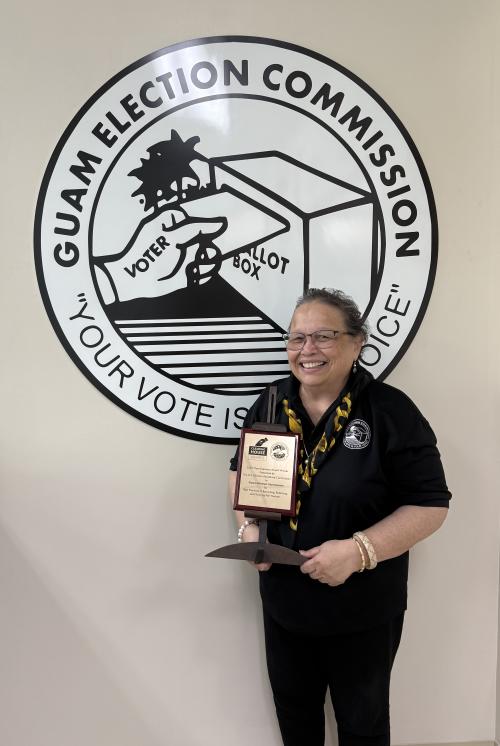
As part of the 10th anniversary of the Clearinghouse Awards, the U.S. Election Assistance Commission (EAC) is spotlighting previous Clearie winners, including the Guam Election Commission (GEC).
The EAC interviewed Executive Director Maria Pangelinan on the Commission’s 2022 Clearie award-winning program, “A Win-Win for the Guam Election Commission and the University of Guam — Poll Workers.” It was recognized in the “Best Practices in Recruiting, Retaining, and Training Poll Workers” category.
EAC Q&A: MARIA PANGELINAN, EXECUTIVE DIRECTOR, GUAM ELECTION COMMISSION
1. How did you learn about the EAC Clearie program, and what motivated you to author your jurisdiction’s Clearie entry?
We first learned about the Clearie Awards via the U.S. Election Assistance Commission’s emailed newsletters. Heartened by the outcome of our recently completed first semester of our Special Studies: Election Administration course at the University of Guam, the Guam Election Commission submitted its application for the 2022 Clearie Awards.
2. What was the motivation behind developing your program?
As with other jurisdictions, recruitment of precinct officials and ensuring that the polls are adequately staffed has been a challenge for the Guam Election Commission. As our agency looked for ways to incentivize more people to engage in the electoral process, we focused on three goals: 1) increasing poll worker compensation, 2) providing opportunities that would appeal to professionals and young voters, and 3) improving our poll worker training program and experience.
To meet our first goal, we used our HAVA Security Grant to increase our poll worker stipends from $350 to $500. For the second, we capitalized on our established relationship with our local university, the University of Guam, by developing a college/professional development course that would offer credits to college students and professionals requiring credits for recertification/reclassification. For our third goal, we are acutely aware of the vast amount of information relayed to our poll workers during the required three-hour training. We developed the course to provide poll workers with a more comprehensive understanding of the electoral process and election administration, to give them ample time to absorb the information and ask questions, and to allow them to establish rapport with our election officials.
Image

3. Tell us more about how the program works.
The program offered two academic credits for university students and three continuing education units (CEUs) for professional development. Additionally, we used our HAVA Security Grant to cover the University of Guam recordation fee for all students and the increase in poll worker stipends from $350 to $500. For any students that didn’t meet the poll worker qualifications, we employed them as election assistants and paid them a stipend of $200.
The course examined and provided real-world experience in the conduct of elections on Guam, with the emphasis on the fundamental right to vote and how elections affect the daily lives of Guam residents and included 12 hours of lecture at the university, an exam, and a practicum: Working as a Precinct Official or Election Assistant on Tuesday, November 8, 2022 at island polling sites.
Image
4. Tell us about the results you have seen.
A total of 26 students availed themselves of the program and worked as precinct officials in our 2022 general election. The precincts in which these individuals were employed operated more efficiently compared to precincts with poll workers who were traditionally trained (i.e., completed the standard mandatory three hour poll worker training). On average, the student-employed precincts closed out earlier and experienced fewer ballot reconciliation issues than other precincts. The program also allowed GEC election officials the opportunity to establish rapport with the students. These collaborative efforts resulted in smoother Election Day operations and the students’ reliability improved the GEC’s retention prospects in future elections.
5. What does recognition by the EAC’s Clearie program mean to your office?
We are a small island and a small agency with limited staff and limited resources. Finding solutions to challenges like poll worker recruitment and retention and funding those solutions is a challenge many jurisdictions face. The EAC’s Clearie program recognition validates our efforts in meeting such challenges at both the national and local levels. It is our hope the EAC’s recognition in our program and efforts will bolster confidence from our legislators in terms of funding and from our electorate in terms of election administration.
6. Would you recommend other jurisdictions submit a Clearie entry?
As election administrators, the Clearie program has given us an opportunity to share our efforts in developing solutions to election challenges, and this platform lays the groundwork for collaboration across jurisdictions to improve election operations. Other jurisdictions should absolutely submit a Clearie entry so that we can all continue to share ideas and learn from each other.