



Image
2024 Clearie Award Winner
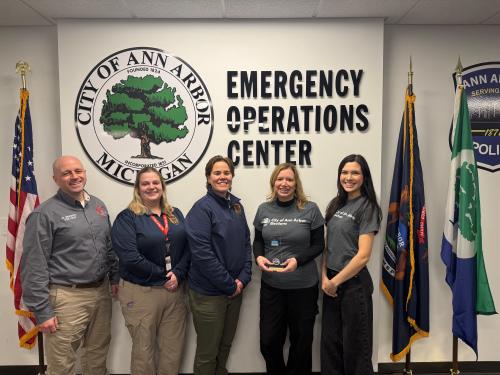
As part of the 10th anniversary of the Clearinghouse Awards, the U.S. Election Assistance Commission (EAC) is spotlighting previous Clearie winners, including the Ann Arbor City Clerk’s Office in Michigan. The office received a 2024 award for Exemplary Contingency Planning and Emergency Response Efforts in the Small/Medium Jurisdictions category.
The EAC interviewed Jacqueline Beaudry, Ann Arbor City Clerk, on the office’s award-winning program, “More Days, More Ways — Planning for a Safe and Secure Election in Ann Arbor, Michigan,” which produced tabletop exercises (TTX) and an Emergency Election Operations handbook to keep elections staff prepared for multiple scenarios.
In addition to this award, the Ann Arbor City Clerk’s Office has received two other Clearie Awards — one in 2019 for Innovations or New Practices in Election Administration and another in 2020 for Creative and Original "I Voted" Stickers.
EAC Q&A: JACQUELINE BEAUDRY, ANN ARBOR CITY CLERK
1. How did you learn about the EAC’s Clearinghouse Awards, and what motivated you to author your jurisdiction’s Clearie entry?
I think I first became aware of the Clearies when the first Michigan award was granted in 2017 to Port Huron Township, Michigan. After that news was shared statewide, our team in Ann Arbor talked about submitting the following year. At that time, we felt that we had a number of innovative projects and new ideas to share, so we submitted an entry in 2018. We were not successful that year, but we did win our first of three awards in 2019! We were successful again in 2020 in the first year of the “Best I Voted Sticker” category as well. That was an exciting one for us, as we had just held our first public art competition for a new sticker. For this most recent award, we also applied again in the first year of a new category, this time for Emergency Response Efforts. This was again perfectly timed for us, as one of the major focuses of our election planning efforts in 2024 was around emergency preparedness.
2. What was the motivation behind conducting the tabletop exercise that was the centerpiece to your “More Days, More Ways — Planning for a Safe and Secure Election in Ann Arbor, Michigan”?
The tabletop exercise grew from a conversation I had with the city’s new Emergency Manager, Sydney Parmenter, to introduce her to my work, specifically around elections. At the time, so many of our local emergency planning exercises revolved around our city’s many large special events — college football games, the summer art fair, etc. I asked Sydney if she would consider an election-related exercise to get city leaders thinking about how our response might be different if an emergency, like a severe weather event, happened on Election Day. She was enthusiastic about the idea from that initial conversation, and we immediately got to work planning a tabletop exercise (TTX) envisioning a major snow event ahead of our state’s presidential primary. One of the takeaways from this exercise that we have shared with other Michigan election officials and emergency managers was the conversations we had about competing interests and conflicting messages. Communication about safety and bad weather is different when you are also still encouraging voters to exercise their rights and get out and vote.
Image
3. Tell us more about the second tabletop exercise you conducted with partners from the University of Michigan and what successes came from that collaborative effort?
After the success of our first exercise, we immediately decided to continue the momentum looking ahead to November 2024. Civil unrest, particularly on campus, became a big part of the planning conversation. We reached out to the University of Michigan to join us in a TTX scenario concentrating on our satellite city clerk office at the U-M Museum of Art (UMMA). Our satellite office is a full-service clerk’s office on campus, offering voter registration, absentee ballots, early voting, and an Election Day vote center.
The TTX centered around our operations at UMMA and was much more focused on law enforcement response and the legal questions surrounding peaceful protesting and campaigning near polling locations. The exercise proved very useful in making introductions between the many different agencies, including local and university police, and our elections team. Conversations again included how to manage competing interests, like the right to peacefully protest, but in a way or a space that did not intimidate voters. Media and communications were also a big topic at this event and how mis- and disinformation can quickly escalate the situation.
This TTX, compared to the first one with the weather scenario, probably started to feel more like an emergency planning meeting than a “what-if scenario” with the national election getting closer. One of the successes of this event was an agreement to create a small working group of officials from the city and university who helped to create an Election Day safety plan for the satellite voting office.
Image
4. What benefits and results have you seen since the implementation of your “More Days — More Ways, Planning for a Safe and Secure Election in Ann Arbor, Michigan”?
Following more than a year of planning and collaboration between the City Clerk’s Office and the City’s Emergency Manager, we now have a written document for emergency operations on Election Day. Our emergency plan is reviewed and revised before each election and distributed to the Emergency Operations Team within the city. A benefit for the city as a result of this partnership is better collaboration and a better understanding of the election planning process for all of our internal and external partners. Each election, members of our City Emergency Operations Center Team (EOC) meet virtually every four hours as a small EOC activation to ensure we are all communicating and everyone is ready should a response be necessary.
This last August, we had a special election, and our preparations and plans were put to the test when we had a power outage at City Hall in the middle of Election Day. Having designated representatives already on the calls made coordinating the response so much more efficient. Another takeaway that is a really easy first step for those new to emergency response planning is just simply learning who is responsible and who to call and getting to know those individuals. You don’t want to be introducing yourself to your public safety partners on the day you need them!
5. What does recognition of your jurisdiction’s entry by the EAC’s Clearie Program mean to the Ann Arbor Clerk’s Office and what impact has that recognition generated?
It is always an honor to have your work recognized by your peers and a national recognition is really special! Getting recognized in this new category for emergency preparedness this year definitely validated all of our hard work and the planning that went into being ready for 2024. Since the award, we’ve continued to share our story with other local officials. Most recently, I accompanied Sydney to a Michigan Emergency Managers conference, and we presented to her peers. Similar to the Michigan clerks, we discovered varying levels of experience and different comfort levels from the group when talking about Election Day emergency response.
6. Would you recommend other election jurisdictions author and submit a future Clearie entry featuring one of their “Best Practices” and why?
Of course! I’ve actually had a number of communities reach out to ask about the application process or for tips on what to include in their entry. In particular, our local “I Voted” sticker competition was replicated by several jurisdictions, and I’ve since seen some of those winning community stickers end up as “Best I Voted Sticker” Clearie winners! For a jurisdiction or official who may think they don’t need the recognition or attention, I’d suggest they still apply and think about the entry as way to share their innovations and best practices. That might be the motivation for some, but I think it also just feels pretty good to be recognized with a Clearie win!
I think one of the best parts about the Clearies is the national election community that has been created, a community that encourages sharing of best practices and collaborating on new ideas. Just like a winning entry may serve as a model for other election officials to incorporate in their offices, it might also be the inspiration needed for a jurisdiction to take a chance and showcase their work in the future.